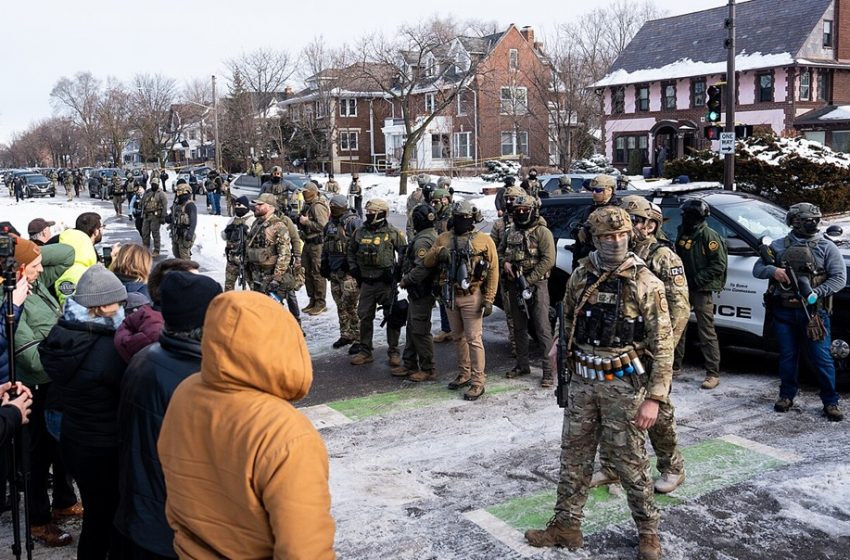
In the early hours of the morning, a figure stands at the edge of a quiet residential street. There is no uniform. No badge. No clipboard. Just a phone in one hand, a jacket pulled tight against the bitter -10° cold, and an attentiveness sharpened by concern for others rather than duty to an institution.
Across parts of Minnesota, scenes like this have become increasingly familiar. Neighbours watch for unfamiliar vehicles and residents warn one another that Immigration and Customs Enforcement (ICE) officers are nearby. People position themselves, quite literally, between perceived threat and vulnerable neighbours.
There is no central command issuing instructions. No official rota. No recognised leader coordinating the response.
And yet, something is clearly organising.
This article is not about immigration policy, nor the legality or legitimacy of enforcement practices. Those debates are important, but they are not my concern here. What interests me is something more fundamental and, arguably, more revealing: the public response itself.
What does it tell us about how humans coordinate under pressure, and why do our traditional ideas of leadership struggle to explain what we are seeing?
Order Without Orders
From the outside, these actions might look chaotic. Roving patrols. Informal warning systems. Neighbours gathering at short notice outside a particular house. Messages circulating rapidly through WhatsApp groups, community pages, and word of mouth.
But look more closely and a different picture emerges.
There is a coherence without choreography, an alignment without authority, and purpose without permission.
No one appears to be waiting for instructions. People simply act, contributing what they can: time, presence, information, reassurance. Some stand watch. Some document events. Some escort children to school. Others provide food, transport, or temporary shelter. The contributions differ, but the direction does not.
This is not an absence of leadership. It is a different form of it.
The Limits of the Leader-Centric Lens
Much of our thinking about leadership is still rooted in relatively stable environments. We imagine leaders setting direction, issuing guidance, allocating roles, and resolving uncertainty from the top down. This model works reasonably well when conditions are predictable and the pace of change is manageable.
But the situation unfolding in Minnesota is anything but stable.
Enforcement activity is unpredictable. Information is incomplete and often contested. The emotional temperature is high. The risks are real, immediate, and unevenly distributed.
In contexts like this, waiting for central coordination is not just inefficient; it is often impossible. By the time a plan is agreed, the situation has already changed.
As far back as the 1800’s, Prussian Field Marshall Helmuth Karl Bernhard Graf von Moltke wrote that, “A favourable situation will never be exploited if commanders wait for orders.” This message still holds true today.
In Minnesota, what we see instead of centralised coordination is rapid, local sensemaking. Individuals interpret what is happening around them and act in ways that make sense given their values, capabilities, and proximity to events. This coordination emerges through shared understanding rather than formal instruction.
This is where traditional leadership models fall short. They assume that order follows authority. What Minnesota suggests is that order can follow meaning.
The North Star in Plain Sight
Despite the absence of formal leadership, there is remarkable consistency in the actions being taken. That consistency points to something important: a shared orienting principle.
You might phrase it in many ways, but the essence is simple: We protect each other.
This is the north star. Not a detailed strategy or policy position, but a clear moral and social orientation. It does not prescribe specific actions; it provides direction.
Once that north star is visible, people no longer need to be told what to do. They simply ask themselves a local, situational question: Given what I can see, and what I can offer, what action best moves us closer to that principle?
One person stands watch. Another sends a message. Another opens their door.
Different actions. Same orientation.
This is a defining feature of what I have previously described as Constellation Leadership.
Constellation Leadership in the Wild
A constellation is not a single star issuing light to others. It is a pattern that emerges when many stars are oriented in relation to one another. The stars do not move to create the pattern; the pattern becomes visible because of their alignment.
Constellation Leadership works in much the same way.
It does not rely on hierarchy, titles, or formal authority. Instead, it depends on three conditions:
- A clear, shared purpose that can be understood without translation.
- Local autonomy, allowing individuals to act based on immediate information.
- Mutual awareness, so actions remain loosely coordinated rather than fragmented.
Minnesota offers a live example of all three.
The purpose is widely understood. The autonomy is unavoidable. And awareness is maintained through constant, informal communication.
Crucially, no one needs to oversee the whole system. Each person only needs to see enough to act responsibly in their part of it and recognise what they can personally contribute towards its achievement.
Why Humans Default to This Pattern
It is tempting to see this kind of organisation as exceptional, something that only appears in moments of crisis. In fact, it may be closer to our default state than we like to admit.
For most of human history, survival depended on small groups responding quickly to immediate threats. There were no org charts. No quarterly plans. No approval gates. Coordination emerged through shared intent, trust, and constant adjustment.
Hierarchy came later, as societies scaled and stability increased. It is a powerful tool, but it is not our only one.
When environments become volatile and morally charged, we often revert to older patterns of coordination. We look sideways, not upwards. We watch one another. We act.
Minnesota is not an anomaly. It is a reminder.
The Uneasy Truth for Formal Organisations
There is an uncomfortable implication here for organisations, institutions, and leaders.
If people can self-organise so effectively in the absence of authority, what does that say about how often hierarchy is used as a substitute for clarity?
In many workplaces, uncertainty triggers a rush towards control: more approvals, more meetings, more escalation. Yet the Minnesota example suggests a different response is possible. When the north star is clear and credible, people do not need to be managed into alignment. They move there naturally.
This does not mean leadership disappears. It changes shape.
Leadership becomes less about directing action and more about holding the purpose steady, protecting the conditions for autonomy, and resisting the urge to over-specify behaviour.
Not Romantic, Not Risk-Free
It would be naïve to romanticise what is happening. Decentralised action carries risks. Information can be wrong. Emotions can escalate. Boundaries can blur.
Constellation Leadership is not inherently virtuous. It is simply adaptive.
The point is not that this model is always preferable, but that it becomes dominant when other models fail to keep pace with reality. Complexity does not ask for permission. It simply overwhelms rigid structures.
What we are witnessing in Minnesota is people responding to complexity with the tools they have always had: shared meaning, local judgement, and collective care.
What This Reveals About Us
Strip away the headlines and the political arguments, and something quietly human remains.
Faced with perceived injustice and threat, people did not wait to be organised. They organised themselves. They did so not because they were told to, but because the direction felt obvious.
This is not chaos. It is not leaderlessness. It is a constellation forming in real time.
And it suggests that beneath our formal structures and institutional roles, we are still wired for something older, more relational, and more adaptive than we often allow.
The question is not whether Constellation Leadership works. It is how often we suppress it, and at what cost.
What happened (and is still happening) on those Minnesota streets was not dramatic in the way leadership is often portrayed. There were no speeches. No charismatic figures. No clear victories.
And yet, it may be one of the clearest demonstrations of how humans actually organise when it matters.
Not through command.
Not through consensus.
But through shared orientation and voluntary contribution.
Constellation Leadership is not a radical invention. It is a rediscovery.
Under pressure, when hierarchy falls away, we do not descend into chaos. We look up, find a north star, and begin to align ourselves accordingly.
Sometimes, that alignment looks like standing quietly outside a neighbour’s house, watching the road, ready to act if needed.
No one in charge.
Everyone responsible.
Photo credit: Chad Davis https://chaddavis.photography/sets/ice-in-minneapolis/

Danny Wareham
Danny Wareham is an organisational psychologist, accredited coach, and speaker, with three decades of experience of helping businesses, leaders and C-suites nurture the culture and leadership required to support their strategy.
He specialises in two key areas:
- Social dynamics: Culture, engagement and how people relate to each other; and
- Personality: What are our individual differences that highlight our strengths and our blind spots
More articles are available on his website: dannywareham.co.uk/articles
Follow or connect: https://www.linkedin.com/in/danny-wareham/